
Mold remediation in Memphis, TN
Mold remediation in Memphis means finding the water that fed the mold, closing off the area, removing what can't be cleaned and drying what stays. Tennessee treats it as contractor work: mold remediation has its own license classification, S-F, and in Shelby County residential jobs from $3,000 up fall under a state license.
Do these first
Right now
- 1Find and stop the water first. Mold keeps spreading as long as the moisture behind it is there.
- 2Close the door to the room and leave the growth alone. Scrubbing it dry or vacuuming it with a household vacuum puts spores in the air.
- 3If the mold is near a return vent or the air handler, don't run the system until someone has looked at it. The EPA warns against running an HVAC system you think has mold in it.
- 4Don't paint over a stain or caulk around it. It hides the problem from the next person who checks.
- 5Take dated photos for your records, and write down when the leak started if you know.
When you call, the call is connected with an independent local company that takes water damage and mold jobs in Memphis. We don't do the work ourselves and can't vouch for whoever picks up, so go through the checks below before anyone starts. How the referral line works.
What it means in a Memphis house
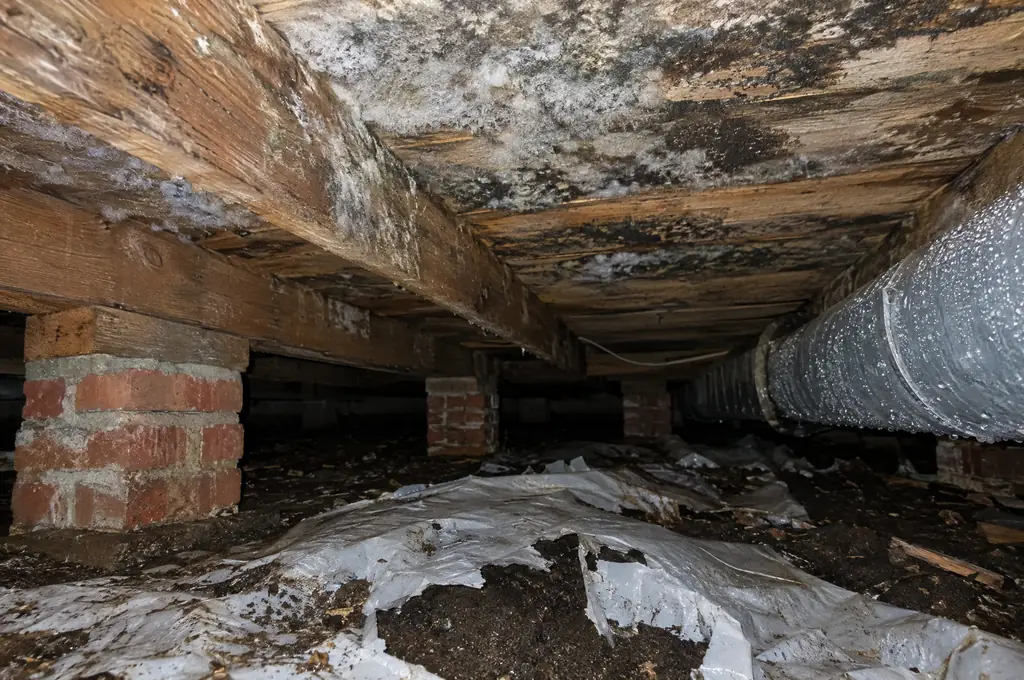
Memphis mold almost always traces back to water that stayed put: a supply line weeping inside a wall, a drain pan that overflowed in the attic, or a crawl space that took on water after a storm and never dried. The EPA's guidance is to dry wet materials within 24 to 48 hours and keep indoor humidity under 60 percent. The weather page on this site shows the live humidity and dew point at Memphis International Airport, which tells you how hard drying will be that day.
Memphis facts for mold remediation
- 1Tennessee lists mold remediation as its own contractor specialty classification, S-F. Tennessee Board for Licensing Contractors: classification outline
- 2A Tennessee contractor license is required before anyone bids or contracts a job of $25,000 or more. Tennessee Board for Licensing Contractors: contractor license
- 3Shelby County is one of nine Tennessee counties where residential repair and remodeling from $3,000 to $24,999 needs the state home improvement license, which carries a $10,000 bond. Tennessee Board for Licensing Contractors: home improvement license
- 4The EPA's guidance is to keep indoor humidity below 60 percent, ideally 30 to 50 percent, and to dry wet materials within 24 to 48 hours. EPA: A Brief Guide to Mold, Moisture and Your Home
- 5April is the wettest month in the Memphis record, with a 1991-2020 normal of 5.87 in.; the year's normal is about 54.94 in. 1991-2020 normals via ACIS, Memphis Area record, calculated by 901 Restoration on November 13, 2026
- 6About 62% of homes in the 25 Memphis ZIP codes on this site were built before 1980, by Census estimates for ACS 5-year 2020-2024. U.S. Census Bureau, ACS 5-year, tables B25034 and B25035, calculated by 901 Restoration on November 13, 2026
How the work usually goes
- Step 1
Moisture check
Pin meters and usually a thermal camera locate the water that is still there. Paint can look dry over drywall that is soaked behind it.
- Step 2
Containment
Plastic sheeting and an air scrubber that pulls air out of the work area keep dust and spores from drifting into the rest of the house.
- Step 3
Removal and cleaning
Moldy drywall, insulation and carpet pad get cut out and bagged, since they can't be cleaned. Joists, studs and other solid wood get cleaned in place.
- Step 4
Drying
Dehumidifiers run until framing and subfloor read dry. On a muggy Memphis week, this step can outlast the removal.
- Step 5
Readings before closing up
Moisture is checked again before new drywall or insulation goes in. If you want independent testing, hire a separate company for it.
The estimator, gives the equipment and drying-time ranges for your square footage. No prices.
How insurance usually reads it
Many homeowners policies limit mold coverage or leave it out, while the water event that caused the mold can be treated differently from the mold itself. Your declarations page and any mold endorsement spell out which applies. Read them, or ask your agent, before work starts so the scope you sign matches what the policy says.
Memphis flood insurance and water damage coverage
What changes the size of the job
- How many square feet of growth there are, and whether the job crosses Tennessee's $3,000 or $25,000 license lines
- Where the growth is: an open wall, the crawl space, the attic, or inside ductwork
- How much drywall, insulation and flooring gets torn out
- The containment and air filtration needed while work goes on
- How many days the drying takes after removal
Before anyone starts
- Jobs of $25,000 or more: a state contractor license. Tennessee requires a contractor license from the Board for Licensing Contractors before anyone bids or contracts a job of $25,000 or more. Ask for the number and look it up yourself. Check on tn.gov
- $3,000 to $24,999 in Shelby County: a home improvement license. Shelby County is one of the Tennessee counties where residential remodeling and repair from $3,000 to $24,999 needs the state home improvement license, which comes with a $10,000 bond. Check on tn.gov
- Mold work: ask about the S-F classification. Tennessee lists mold remediation as its own specialty classification, S-F. On a larger mold job, check that the license on file includes it. Check on tn.gov
- Proof of insurance. Ask for a current certificate of general liability insurance in the company's own name, and check the dates, before equipment comes through the door.
- A written estimate first. Get the scope on paper, line by line, before work starts. Don't sign anything with blank spaces in it, and don't pay the full amount up front.
Tennessee lists mold remediation as its own contractor specialty (S-F). A state contractor license is required for jobs of $25,000 or more, and in Shelby County residential jobs from $3,000 to $24,999 fall under the state's home improvement license.
Related problems in Memphis homes
- Burst and frozen pipes in Memphis
Split supply lines in crawl spaces, attics and outside walls. Shut off at the house, then get the water out the same day.
- Flood and storm water in Memphis
Flash flood, creek or river water that came in from outside. Treated as contaminated water, then dried under containment.
- Sewer backups in Memphis
Sewage up through a floor drain, toilet or tub. Keep everyone away, stop using water, and have it cleaned as contaminated water.
Local data: today's Memphis humidity and dew point. Service area: the 25 Memphis ZIP codes we connect calls from.
Questions about mold remediation in Memphis
Does Tennessee require a license for mold remediation in Memphis?
For most real jobs, yes. Tennessee lists mold remediation as its own contractor specialty, S-F. A state contractor license is required before anyone bids or contracts a job of $25,000 or more, and Shelby County is one of the counties where residential jobs from $3,000 to $24,999 need the state home improvement license. You can check any license number on the state's Verify a License page.
Do I need mold testing before remediation?
Not usually. The EPA's cleanup guidance is built around finding the moisture and removing the growth, not around lab results. Testing can help in a dispute or when you smell mold but can't find it. If you want it, hire a tester who isn't the company doing the removal.
Is a small mold spot something I can handle?
The EPA says a patch under about 10 square feet, roughly 3 feet by 3 feet, is usually a homeowner job. If it's bigger, if a lot of water was involved, or if sewage or flood water caused it, the EPA points to a professional.
Why does mold keep coming back under my house?
Because the crawl space never fully dries. Standing water after a storm, a slow supply line leak or an AC drain that empties under the house can keep joists damp for weeks. Fix the water source first, then dry and clean the wood, or the growth returns.
Sources for this page: EPA: A Brief Guide to Mold, Moisture and Your Home; EPA: Mold Cleanup in Your Home; Tennessee Board for Licensing Contractors: classification outline (S-F Mold Remediation); Tennessee Board for Licensing Contractors: contractor license ($25,000 and up); Tennessee Board for Licensing Contractors: home improvement license (Shelby County, $3,000 to $24,999).
Water still coming in?
Call (901) 256-4999